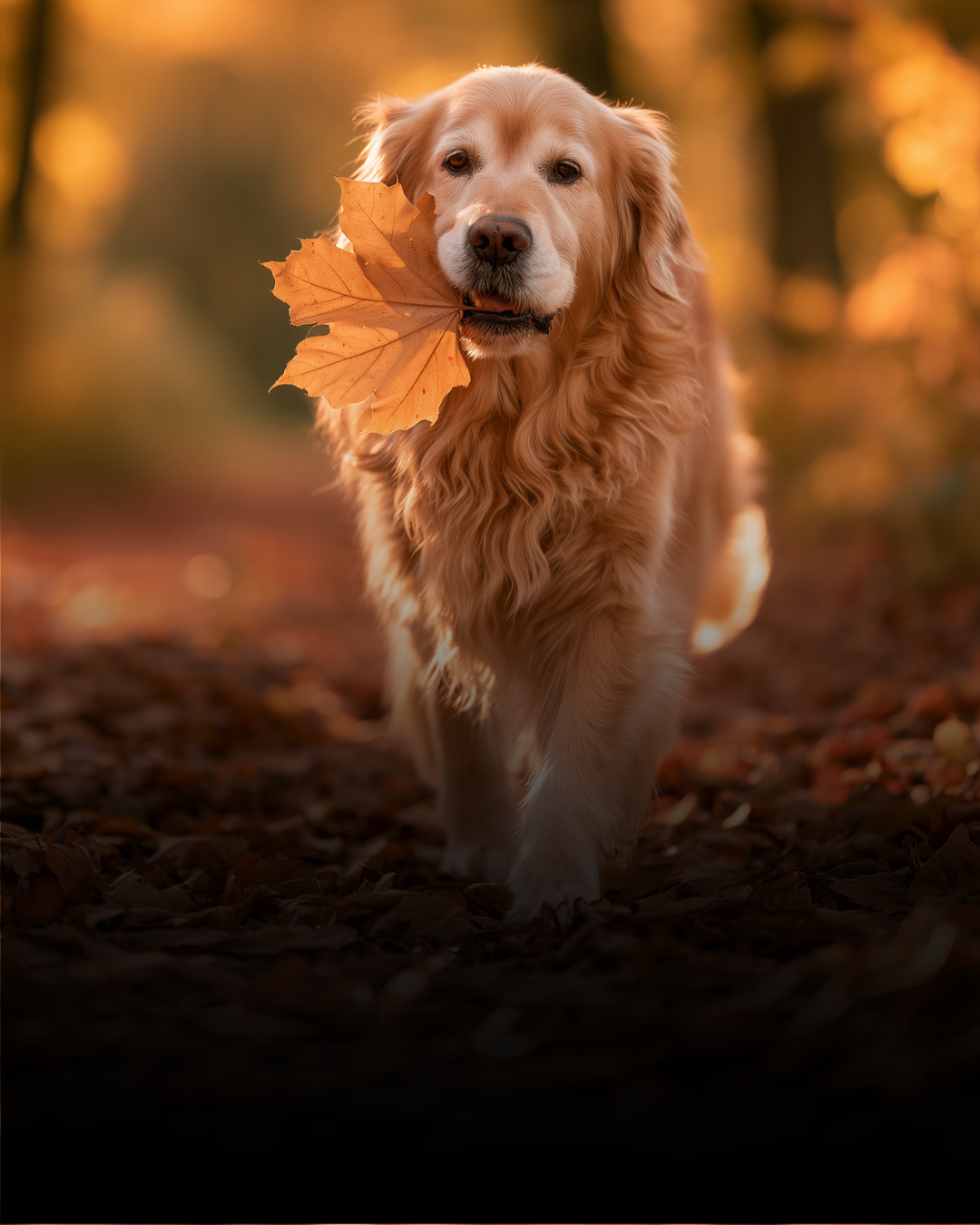
Osteoarthritis and humidity: protecting your dog in autumn
Does your dog seem stiffer in autumn? Explore the links between humidity, cold and osteoarthritis, and practical ways to support joint comfort.
Pauline Durepaire
Published in
Practical TipsThe first rains return, mornings grow cooler… and your dog seems to take longer to leave their bed. They hesitate at steps, slow down on walks or prefer to stay lying down. Why do these difficulties sometimes seem more pronounced in autumn?
Cold weather, changing conditions and new seasonal habits can combine. However, the direct effect of humidity on osteoarthritis pain in dogs remains uncertain.
The aim is therefore to observe your companion and adapt their daily routine: maintain regular activity, provide comfortable rest and make movement easier. Here are practical ways to make autumn more comfortable.
Why do some dogs seem stiffer in autumn?
Osteoarthritis is a chronic disease affecting the whole joint. It involves changes in joint tissues, inflammation and pain that can restrict movement. Its management relies on several complementary approaches.
Weather sensitivity that remains difficult to explain
The feeling that pain worsens when the weather changes is also common in humans. Some studies find modest associations with humidity, wind or atmospheric pressure. Others do not confirm them. These findings cannot be directly applied to dogs. Dixon et al., 2019 ; Ferreira et al., 2024.
Cold may alter the sensitivity of pain pathways: experimental studies in rats explore this possibility. However, they do not demonstrate what happens in a dog with osteoarthritis during an autumn walk. Kim et al., 2024.
What the evidence in dogs shows
What research shows: in 62 dogs with osteoarthritis, no statistically significant relationship was found between the weather variables studied and pain scores reported by owners. Average temperature and day length were associated with measured activity, but explained less than 1% of its variation.
— Katz et al., 2017
This study does not rule out individual sensitivity. It suggests that humidity should not be presented as a proven cause of worsening symptoms.
Autumn can also bring several changes: shorter walks, longer periods of rest and movement on slippery surfaces. Observed stiffness deserves attention, even when its link with the weather remains uncertain.
Maintaining regular activity despite the rain
When showers follow one another, walks sometimes become brief toilet breaks. This change in habits deserves as much attention as the outdoor temperature.
What research shows: in a survey of 3,153 owners, 48.2% said they were less likely to exercise their dog in cold weather, compared with 25.3% in the rain. These findings describe reported habits; they do not directly measure osteoarthritis pain.
— Hall et al., 2021
Choosing suitable walks
Short walks spread throughout the day may be easier to tolerate than an occasional long outing. Their duration should be adjusted with your veterinarian according to your dog's pain, mobility and fitness.
Start gently. Choose a flat route that makes it easy to return home, and avoid making up for several inactive days with a suddenly much more demanding outing.
Ball throwing involving sudden acceleration and changes of direction should also be avoided in dogs with osteoarthritis. Prefer controlled walking and suitable calm activities.
Observing the quality of movement
What research shows: in 56 dogs with osteoarthritis monitored for 49 days using a sensor, total activity was higher at weekends than on weekdays. However, activity measurements were not strongly associated with pain assessments.
— Lee et al., 2021
The duration of a walk is therefore not enough to assess joint comfort. Also observe how your dog walks, gets up and recovers after the outing.
Keeping your dog dry and making rest comfortable
After a wet walk, gently dry their coat, belly and paws. Keep a towel near the entrance to establish this small routine without making outings more complicated.
A waterproof coat may improve comfort for a dog sensitive to cold or easily soaked. Choose it according to their coat, body shape and reactions. It must allow the shoulders and hips to move freely.
These precautions aim to keep your dog thermally comfortable. They are not a treatment for osteoarthritis.
A comfortable, accessible bed
Place their bed in a dry spot, away from draughts. Above all, check how your dog lies down in it and gets up.
A bed that is too deep or difficult to step into can make these movements harder. Choose a comfortable, stable and easily accessible support. If your companion abandons their usual bed, observe what seems to be bothering them.
Choosing appropriate bedding is among the adaptations recommended for older animals in pain.
Read our article on orthopaedic dog beds
Making movement safer
Wet leaves, damp steps and smooth patios can make outings more difficult. Indoors, wet paws also make movement harder on some floors.
Follow the route with your dog: from their bed to the door, then to the garden or street. Where do they hesitate? Where do their paws slip?
A few adjustments can make daily life easier:
- place non-slip mats on frequently used routes;
- clear wet leaves from the entrance;
- limit jumping into the car;
- provide a stable, non-slip ramp if it suits your dog;
- keep water and resting places easily accessible.
These adaptations are part of the recommended support for mobility difficulties.
Monitoring weight and joint comfort
When outings decrease, feeding habits sometimes stay the same. Treats to keep your dog occupied and small rewards can then be added to their usual ration.
Maintaining an appropriate weight is a priority in managing osteoarthritis. Your veterinarian can assess your dog's body and muscle condition, then adjust their diet to their needs.
What role do omega-3s play?
The omega-3 fatty acids EPA and DHA are among the nutritional options recommended for dogs with clinical osteoarthritis. Their intake must take account of the existing diet and individual needs.
A supplement fits into a programme combining veterinary follow-up, diet, suitable activity and everyday adaptations. It does not replace pain management.
Explore our guide to omega-3s
Identifying changes that matter
Note new difficulties: getting up more slowly, shorter walks, hesitation at a step or disturbed sleep. A short video can help your veterinarian understand what you observe at home.
If your dog stops bearing weight on a leg, is in severe pain or suddenly loses the ability to walk, contact a veterinarian promptly. Do not wait for the weather to improve.
FAQ
Conclusion
Protecting a dog with osteoarthritis in autumn calls for an attentive routine: maintain suitable outings, dry their coat, make movement safer and provide comfortable rest.
Owners' observations matter, even when weather-related mechanisms remain uncertain. If your dog moves less or finds it harder to get up, have their care reassessed.
To support this approach, discover PERNIXOL®, Laboratoire Sensilia's range of dietary supplements for canine joint comfort.


Scientific references
- Katz EM, Scott RM, Thomson CB, Mesa E, Evans R, Conzemius MG. Evaluation of the Environmental Bias on Accelerometer-Measured Total Daily Activity Counts and Owner Survey Responses in Dogs with Osteoarthritis. Vet Comp Orthop Traumatol. 2017;30(6):385–390. doi:10.3415/VCOT-17-02-0028.
- Lee AH, Detweiler KB, Harper TA, Knap KE, de Godoy MRC, Swanson KS. Physical activity patterns of free living dogs diagnosed with osteoarthritis. J Anim Sci. 2021;99(8). doi:10.1093/jas/skab204.
- Hall EJ, Carter AJ, Farnworth MJ. Exploring Owner Perceptions of the Impacts of Seasonal Weather Variations on Canine Activity and Potential Consequences for Human–Canine Relationships. Animals. 2021;11(11):3302. doi:10.3390/ani11113302.
- Kim SH, et al. Effects of Repeated Exposure to Ambient Cold on the Development of Inflammatory Pain in a Rat Model of Knee Arthritis. Life. 2024;14(11):1428. doi:10.3390/life14111428.
- Dixon WG, et al. How the weather affects the pain of citizen scientists using a smartphone app. npj Digit Med. 2019;2:105. doi:10.1038/s41746-019-0180-3.
- Ferreira ML, Hunter DJ, Fu A, Raihana S, Urquhart D, Ferreira PH. Come rain or shine: Is weather a risk factor for musculoskeletal pain? A systematic review with meta-analysis of case-crossover studies. Semin Arthritis Rheum. 2024;65:152392. doi:10.1016/j.semarthrit.2024.152392.
- Cachon T, et al. COAST Development Group’s international consensus guidelines for the treatment of canine osteoarthritis. Front Vet Sci. 2023;10:1137888. doi:10.3389/fvets.2023.1137888.
- Proposed Canadian Consensus Guidelines on Osteoarthritis Treatment Based on OA-COAST Stages 1–4. Front Vet Sci. 2022;9:830098. doi:10.3389/fvets.2022.830098.
- Mille MA, McClement J, Lauer S. Physiotherapeutic Strategies and Their Current Evidence for Canine Osteoarthritis. Vet Sci. 2023;10(1):2. doi:10.3390/vetsci10010002.
- American Animal Hospital Association. 2023 AAHA Senior Care Guidelines for Dogs and Cats — Pain Management. 2023.
This article was written by the R&D team at Laboratoire Sensilia, experts in animal nutrition.


