Gentle exercises to relieve a dog with arthritis
Discover gentle exercises for dogs with arthritis, including walking, swimming and proprioception, and learn how to preserve mobility without placing excessive strain on the joints.
Pauline Durepaire
Published in
Practical TipsWhen dealing with joint pain, many owners wonder: should you keep your dog active or let them rest completely?
From a veterinary perspective, the answer is clear: movement remains essential, provided you choose the right exercises. Let's explore why, how, and which types of activity can genuinely help a dog with arthritis.
Why movement remains essential in cases of arthritis
Contrary to popular belief, arthritis should not mean immobility. While the joints are painful, complete inactivity speeds up stiffness and leads to muscle loss. Muscles provide natural support for the joints: the stronger they are, the more effectively they reduce pressure on damaged areas.
Movement also stimulates the production of synovial fluid, a natural joint lubricant, which reduces friction and nourishes the cartilage.
Dogs with arthritis supplemented with Omega-3 and following a gentle exercise programme show significant improvements in weight-bearing and daily mobility.
In summary: it is better to move a little every day than to remain completely at rest.
The principles of suitable exercise
For movement to be beneficial rather than painful, a few simple rules make all the difference:
- Duration: 5 to 15 minutes per session, repeated several times a day.
- Intensity: avoid sudden movements and favour steady, consistent activity.
- Surface: soft ground (grass, sand, soil) rather than tarmac.
- Goal: maintain joint flexibility, muscle mass, and coordination.
These activities can be compared to the daily warm-up of a senior athlete: gentle but regular, they help the body stay active without putting it under strain.
5 gentle exercises recommended for dogs with arthritis
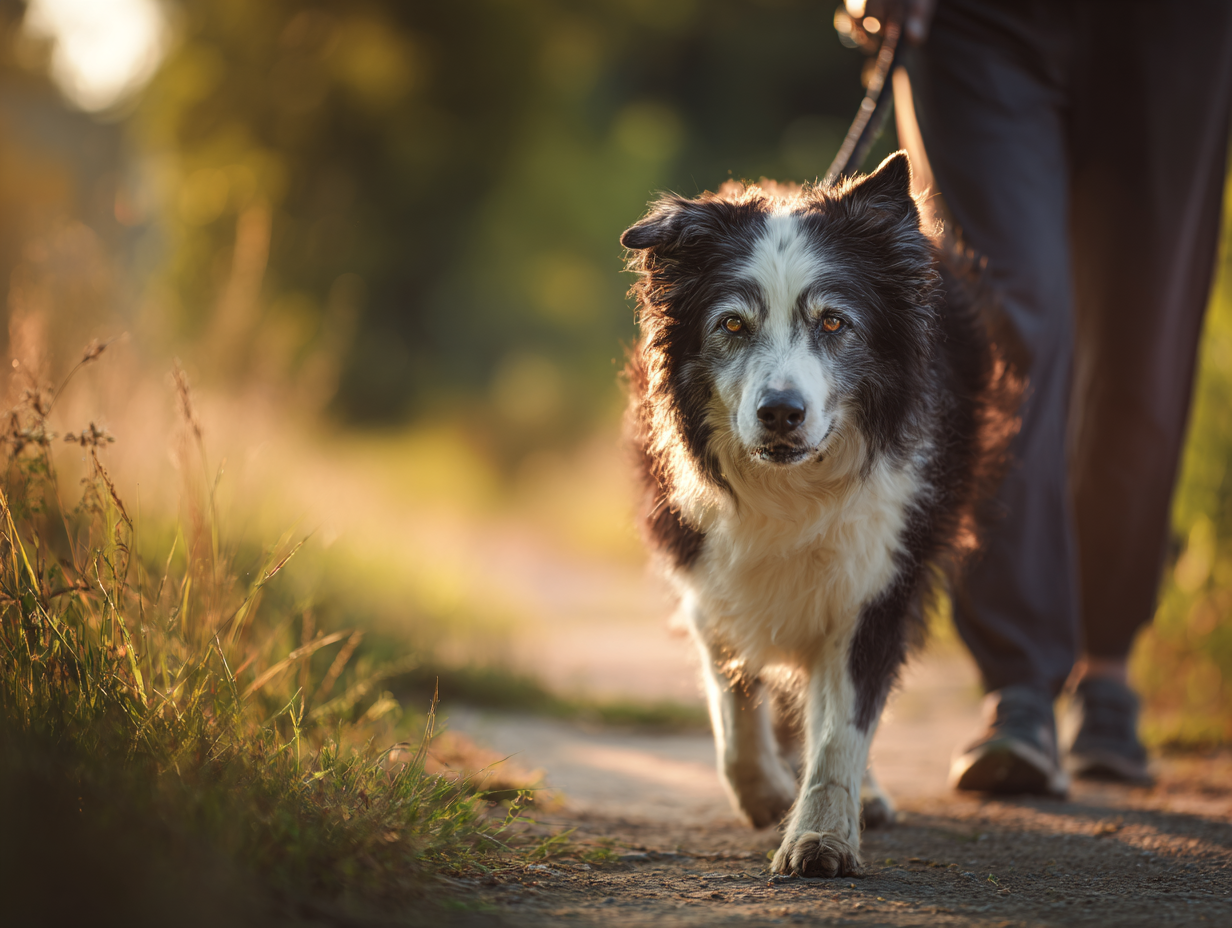
1. Walking on flat ground
Walking is the simplest and most accessible activity. It stimulates joint lubrication and maintains endurance. Practical tip: opt for several short daily walks rather than one long outing.
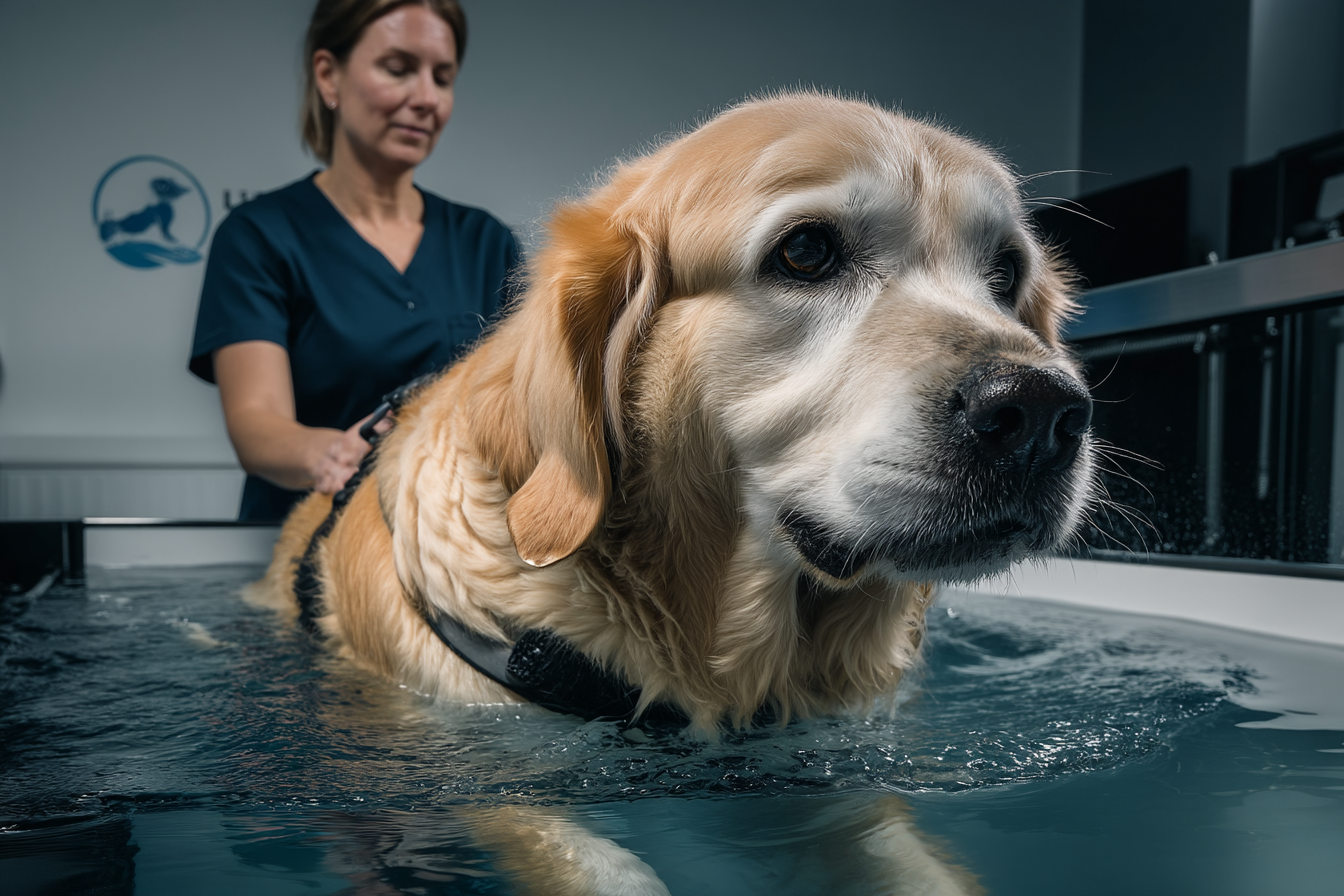
2. Swimming and hydrotherapy
Buoyancy reduces the load placed on the body and allows for significant muscle effort without impact on the joints.
- A study by Lee (2000) found that dogs with arthritis using an underwater treadmill showed a notable improvement in mobility.
- In addition, swimming exercises the heart and strengthens the deep muscles.
Be mindful of water temperature, however: cold water can increase muscle tension in a dog with arthritis.
3. Simple proprioception exercises
Walking your dog on varied surfaces (tall grass, sand, moss) helps stimulate their coordination. This may seem minor, but these small adjustments strengthen the stabilising muscles and maintain flexibility.
4. Gentle stretching
Carried out carefully and ideally guided by a vet or an animal physiotherapist, stretching helps to reduce stiffness. As with people stretching after waking, this gentle movement can restore mobility and relax the tissues.
5. Light muscle strengthening
A short walk on a gentle slope or climbing two or three low steps can help strengthen the hindquarters. The benefit is significant: the more toned the muscles, the less strain is placed on the joints.
Exercises to avoid at all costs
Certain movements worsen arthritis because they put sudden stress on the joints:
- Repeated ball throwing with sudden stops.
- Fast running or repeated jumping.
- Playing on slippery floors (tiles, wooden flooring).
These activities involve twisting and impact, which can cause pain and increase the risk of injury.
Combining exercise and nutritional support
The benefits of gentle exercise can be enhanced when combined with a diet enriched with omega-3 fatty acids (EPA and DHA).
- Studies by Moreau et al. (2013) and Mehler et al. (2016) show that dogs with arthritis fed a diet rich in omega-3 fatty acids exhibit improved mobility and reduced joint inflammation.
- For example, green-lipped mussel oil and microalgae oil provide highly bioavailable omega-3 fatty acids, which help modulate inflammation and support joint tissues.
FAQ
Conclusion
Arthritis should not condemn a dog to immobility. On the contrary, a programme of gentle, regular and tailored exercise is one of the best ways to relieve pain, preserve mobility, and improve quality of life.
By combining these practices with a balanced diet rich in omega-3 fatty acids, you give your dog the best chance to stay active, happy and close to you for longer.
Scientific references
- Roush JK, Cross AR, Renberg WC, Dodd CE, Sixby KA, Fritsch DA, Allen TA, Jewell DE, Richardson DC, Leventhal PS, Hahn KA. Evaluation of the effects of dietary supplementation with fish oil omega-3 fatty acids on weight bearing in dogs with osteoarthritis. J Am Vet Med Assoc. 2010 Jan 1;236(1):67-73. doi: 10.2460/javma.236.1.67. PMID: 20043801.
- Adler N, Schoeniger A, Fuhrmann H. Polyunsaturated fatty acids influence inflammatory markers in a cellular model for canine osteoarthritis. J Anim Physiol Anim Nutr (Berl). 2018 Apr;102(2):e623-e632. doi: 10.1111/jpn.12804. Epub 2017 Oct 13. PMID: 29030883.
- Lee, J. The effects of an underwater treadmill physical therapy program on two dogs with osteoarthritis. Chancellor's Honors Program Projects. 2000.
- Moreau M, Troncy E, Del Castillo JR, Bédard C, Gauvin D, Lussier B. Effects of feeding a high omega-3 fatty acids diet in dogs with naturally occurring osteoarthritis. J Anim Physiol Anim Nutr (Berl). 2013 Oct;97(5):830-7. doi: 10.1111/j.1439-0396.2012.01325.x. Epub 2012 Jul 14. PMID: 22805303.
- Mehler SJ, May LR, King C, Harris WS, Shah Z. A prospective, randomized, double blind, placebo-controlled evaluation of the effects of eicosapentaenoic acid and docosahexaenoic acid on the clinical signs and erythrocyte membrane polyunsaturated fatty acid concentrations in dogs with osteoarthritis. Prostaglandins Leukot Essent Fatty Acids. 2016 Jun;109:1-7. doi: 10.1016/j.plefa.2016.03.015. Epub 2016 Mar 30. PMID: 27269707.
This article was written by the R&D team at Laboratoire Sensilia, experts in animal nutrition.



