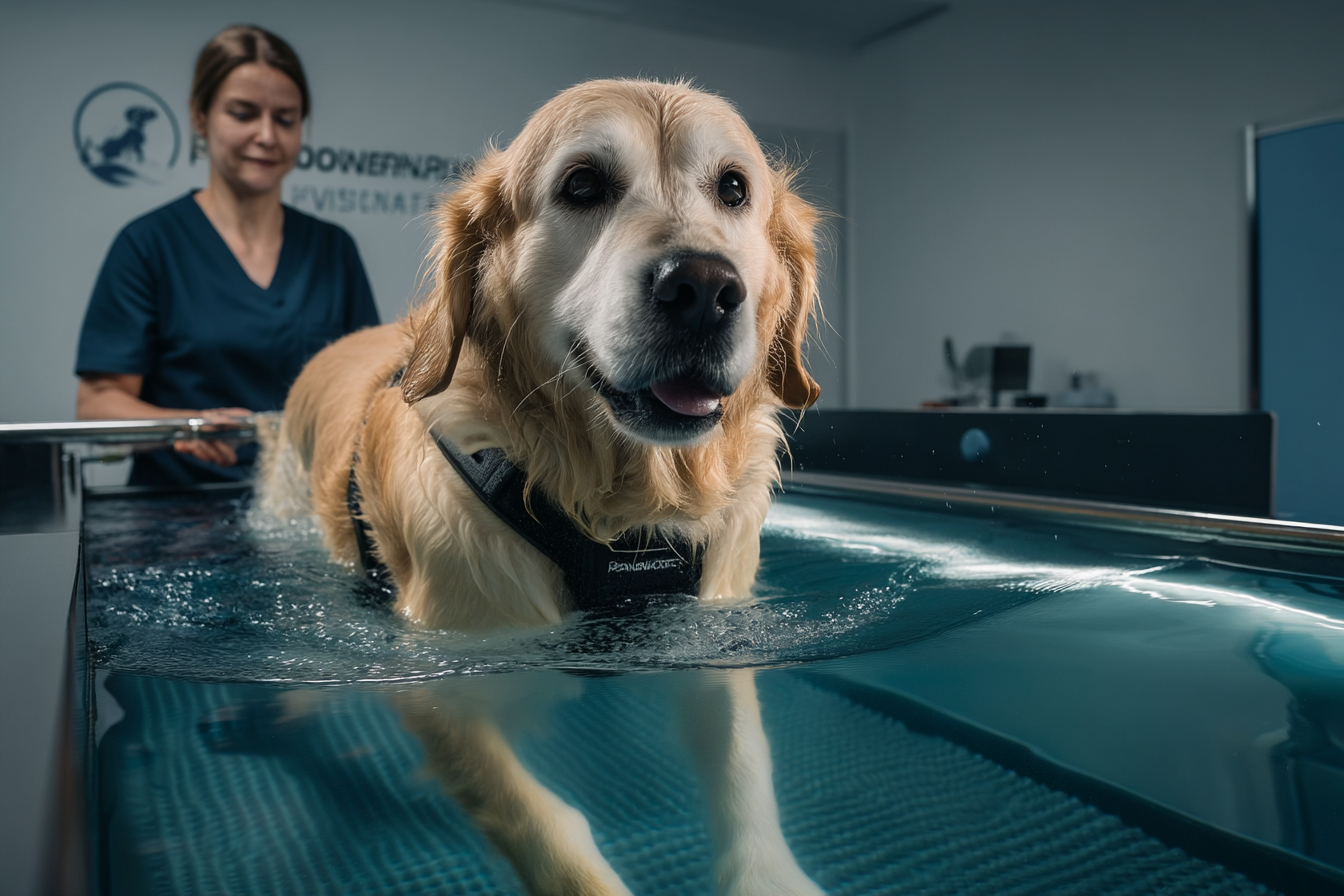
Hydrotherapy for dogs: what are the benefits?
Discover how hydrotherapy helps dogs regain mobility, joint comfort, and muscle mass through the benefits of water.
Pauline Durepaire
Published in
Dog Joint HealthAmong the rehabilitation solutions used in veterinary medicine, hydrotherapy is now widely used. Thanks to the properties of water, it exercises the muscles and mobilises the joints while reducing the strain placed on the body.
But what are its actual benefits? In which cases is it recommended? And what does science say about it? Let's take a closer look.
What is canine hydrotherapy?
Hydrotherapy is a rehabilitation method that uses the properties of water to improve mobility, strengthen muscles, and support functional recovery in dogs with locomotor disorders.
It is mainly carried out using an underwater treadmill or, less commonly, in a pool. Water creates a particularly beneficial environment: it reduces the weight borne by the joints through buoyancy, while offering natural resistance that stimulates the muscles.
This combination allows the dog to move more easily, with less pain, while still getting effective exercise.
Hydrotherapy is now frequently used in dogs with:
- osteoarthritis;
- hip or elbow dysplasia;
- neurological disorders;
- severe excess weight;
- or as part of rehabilitation after orthopaedic surgery.
Its goal is not only to improve mobility, but also to preserve the dog's independence and quality of life over the long term.
Why is water beneficial for joints?
The effectiveness of hydrotherapy is based on three fundamental properties of water: buoyancy, resistance, and hydrostatic pressure.
Buoyancy reduces joint strain
When the dog is immersed, part of its weight is naturally supported by the water. Painful joints therefore experience less strain during movement.
A study published in the American Journal of Veterinary Research showed that immersion up to the hip could reduce the load on the limbs by approximately 62%. This reduction is particularly valuable in dogs with osteoarthritis, dysplasia, or in the recovery phase after surgery.
Immersion up to the hip reduces the load borne by the dog's limbs by approximately 62%.
Water resistance supports muscle strengthening
Contrary to what you might think, hydrotherapy is not a passive exercise. Water provides natural resistance to movement, requiring the dog to engage its musculature more actively.
This resistance helps to strengthen the muscles that support the joints while limiting the impact associated with exercise on firm ground.
A more comfortable environment for movement
In dogs experiencing pain, fear of discomfort often leads to a decrease in physical activity. Yet the less a dog moves, the more muscle mass and mobility it loses.
By reducing mechanical strain, water allows the dog to regain a greater range of smoother movement. This gradual return to movement is one of the main goals of functional rehabilitation.
But are these theoretical benefits actually observed in practice? Scientific studies carried out in recent years provide particularly interesting answers.
What do studies say about hydrotherapy for dogs?
Long considered a complementary approach, hydrotherapy is now supported by a growing body of scientific research demonstrating its effects on mobility, pain, and functional recovery in dogs.
A single session can already improve mobility
In a study published in the Veterinary Journal in 2018, Preston and Wills studied Labrador retrievers with elbow dysplasia. After a single underwater treadmill session, the researchers observed a significant increase in joint range of motion as well as an improvement in stride length.
A single hydrotherapy session increased elbow range of motion and stride length in Labradors with elbow dysplasia.
These results suggest that the benefits of hydrotherapy can appear quickly, even in dogs with chronic joint disease.
Complete programmes produce lasting benefits
The effects appear even more marked when hydrotherapy is integrated into a rehabilitation programme over several weeks.
A pilot study published in 2025 in the journal Animals followed 50 dogs with various orthopaedic and neurological conditions. After a programme of 10 underwater treadmill sessions spread over five weeks, the researchers noted a significant improvement in mobility across all joints assessed.
The greatest improvements were seen in:
- the hip (+5.6%);
- the stifle (+5.2%);
- the carpus (+3.6%).
Interestingly, improvements were observed in dogs of all ages, with no significant difference between young and older animals.
Reduced pain and better muscle maintenance
In a randomised clinical study published in Revue Vétérinaire Clinique involving 32 dogs with hip dysplasia, researchers compared several rehabilitation approaches over two months: hydrotherapy, therapeutic laser, a combination of both, or no treatment.
Dogs that received hydrotherapy showed:
- a significant reduction in pain scores;
- an improvement in their quality of life;
- better maintenance of hind limb muscle mass;
- an improvement in hip joint range of motion.
These results are particularly important, as muscle loss is one of the main consequences of osteoarthritis and dysplasia.
A full-body workout
Contrary to a common misconception, the underwater treadmill is not used solely to unload the joints.
A study published in 2023 in the journal Research in Veterinary Science showed that walking in water increases heart rate and muscle engagement, even at a moderate speed. Hydrotherapy is therefore a genuine form of physical exercise, capable of stimulating the cardiovascular system while remaining more comfortable for the joints than exercise on dry land.
Taken together, this research confirms that hydrotherapy is not limited to improving the dog's comfort: it actively supports functional recovery, muscle maintenance, and long-term mobility preservation.
The proven benefits of hydrotherapy
- Relieves the joints
- Reduces pain and stiffness
- Increases range of motion
- Preserves muscle mass
- Gently strengthens muscles
- Supports recovery
- Improves balance and coordination
- Stimulates the cardiovascular system
- Helps with weight management
Does hydrotherapy have limitations?
Despite its many benefits, hydrotherapy is not suitable for every situation.
Certain contraindications must be taken into account:
- skin or ear infections;
- unhealed wounds;
- certain heart or respiratory conditions;
- unstabilised acute pain;
- certain severe neurological conditions.
A prior veterinary examination remains essential to determine whether this approach is suitable for the dog and to define the most appropriate work parameters.
It is also important to remember that hydrotherapy is generally not a standalone solution. The best results are achieved when it is part of a comprehensive care plan combining adapted physical activity, weight management, veterinary follow-up, and nutritional support.
FAQ
Conclusion
Hydrotherapy is now a recognised form of rehabilitation for dogs with joint, neurological, or recovery-related disorders. By reducing strain on the joints while encouraging movement, it helps improve mobility, preserve musculature, and support day-to-day comfort.
To achieve the best results, it is generally integrated into a comprehensive approach combining adapted physical activity, weight management, and nutritional support. Certain joint supplements, such as PERNIXOL®, can complement the measures used to preserve the dog's mobility and quality of life over the long term.
Discover PERNIXOL®
Scientific references
- T. Preston, A.P. Wills, A single hydrotherapy session increases range of motion and stride length in Labrador retrievers diagnosed with elbow dysplasia, The Veterinary Journal, Volume 234, 2018, Pages 105-110, ISSN 1090-0233, https://doi.org/10.1016/j.tvjl.2018.02.013.
- Levine, D., Marcellin-Little, D. J., Millis, D. L., Tragauer, V., & Osborne, J. A. (2010). Effects of partial immersion in water on vertical ground reaction forces and weight distribution in dogs. American Journal of Veterinary Research, 71(12), 1413-1416. Retrieved Jun 10, 2026, from https://doi.org/10.2460/ajvr.71.12.1413
- Parkinson, S. & Wills, Alison & Tabor, Gillian & Williams, Jane. (2018). Effect of water depth on muscle activity of dogs when walking on a water treadmill. Comparative Exercise Physiology. 14. 1-12. 10.3920/CEP170031.
- M.S. de Oliveira Reusing, C.H. do Amaral, K.A. Zanettin, S.H. Weber, J.A. Villanova Jr., Effects of hydrotherapy and low-level laser therapy in canine hip dysplasia: A randomized, prospective, blinded clinical study, Revue Vétérinaire Clinique, Volume 56, Issue 4, 2021, Pages 177-184, ISSN 2214-5672, https://doi.org/10.1016/j.anicom.2021.08.001.
- Takuma Miyata, Saya Kawai, Aoi Yasuki, Katsumi Ishioka, Changes in physiological parameters in healthy dogs on an underwater treadmill when the water level is set at the hip joint, Research in Veterinary Science, Volume 161, 2023, Pages 20-22, ISSN 0034-5288, https://doi.org/10.1016/j.rvsc.2023.05.013.
- Twarowska, J., Strychalski, J., & Gugołek, A. (2025). A Pilot Study on the Effects of a 10-Session Underwater Treadmill Programme on Canine Joint Range of Motion. Animals, 15(21), 3186. https://doi.org/10.3390/ani15213186
- Barnicoat, Freya & Wills, Alison. (2016). Effect of water depth on limb kinematics of the domestic dog (Canis lupus familiaris) during underwater treadmill exercise. Comparative Exercise Physiology. 12. 199-207. 10.3920/CEP160012.
- Bliss M, Terry J, de Godoy RF. Limbs kinematics of dogs exercising at different water levels on the underwater treadmill. Vet Med Sci. 2022 Nov;8(6):2374-2381. doi: 10.1002/vms3.947. Epub 2022 Sep 14. PMID: 36104830; PMCID: PMC9677400.
- Hodgson H, Blake S, de Godoy RF. A study using a canine hydrotherapy treadmill at five different conditions to kinematically assess range of motion of the thoracolumbar spine in dogs. Vet Med Sci. 2023 Jan;9(1):119-125. doi: 10.1002/vms3.1067. Epub 2022 Dec 29. PMID: 36580393; PMCID: PMC9856978.
- Vitger AD, Bruhn-Rasmussen T, Pedersen EO, Fuglsang-Damgaard LH, Harrison AP. The impact of water depth and speed on muscle fiber activation of healthy dogs walking in a water treadmill. Acta Vet Scand. 2021 Nov 24;63(1):46. doi: 10.1186/s13028-021-00612-z. PMID: 34819127; PMCID: PMC8611859.
- Fernandes, Mayara Marques & Cruz, Ana & Nunes, Bárbara & Soares, Deborah & Mustafa, Thais & Peruquetti, Patricia & Malavazi, Patrícia & Pacheco, Acácio & Souza, Soraia. (2022). Physiological effects of land and water treadmill exercise in dogs. Ciência Rural. 52. 10.1590/0103-8478cr20210092.
This article was written by the R&D team at Laboratoire Sensilia, experts in animal nutrition.



