Diet and osteoarthritis: 5 pillars for your dog's comfort
Canine osteoarthritis: 5 nutritional pillars to reduce inflammation, protect cartilage, preserve muscle mass, support the microbiota, and manage weight.
Pauline Durepaire
Published in
Dog Joint HealthOsteoarthritis cannot be cured by diet alone. But feeding a dog with joint disorders well means offering greater comfort, less inflammation, and sometimes a genuine return to mobility.
Still too often overlooked, nutrition is nevertheless one of the most effective ways to help limit the progression of joint discomfort. Reducing pain, supporting cartilage, preventing excess weight, strengthening muscle mass and protecting the microbiota: nutrition can contribute to all of these goals, provided it is chosen carefully.
Here are the 5 pillars of a diet suited to dogs with osteoarthritis, based on the latest scientific data.
Reduce inflammation with the right fats
One of the major focuses in joint nutrition is the balance between Omega-6 (pro-inflammatory in excess) and Omega-3 (anti-inflammatory and protective). Most dogs' diets are imbalanced, with ratios ranging from 10:1 to 20:1, due to the widespread use of vegetable oils (sunflower, corn, soy) in commercial pet foods.
A diet rich in marine Omega-3 improves mobility and performance in dogs with naturally occurring osteoarthritis.
Marine omega-3 fatty acids, EPA and DHA, are the most effective for reducing inflammatory mediators (PGE2, TNF-α, IL-1β). They are found in:
- fish oil (salmon, sardine, anchovy),
- New Zealand green-lipped mussel oil (Perna canaliculus)
- marine algae oil (Schizochytrium sp.).
Practical tip: choose a diet rich in marine omega-3 fatty acids (EPA and DHA)
Discover our guide to Omega-3
Maintain muscle mass with quality protein
Muscles support the joints. The less lean mass a dog has, the more difficult movement becomes. And with the sedentary lifestyle imposed by pain, the risk of muscle wasting increases.
Contrary to a common misconception, an older or arthritic dog does not need less protein, but higher-quality protein.
It is best to prioritise:
- highly digestible proteins (egg, poultry, fish),
- proteins rich in essential amino acids to support tissue rebuilding and prevent sarcopenia.
Avoid low-quality animal protein sources that are poorly digestible and often found in budget kibble.
Support gut microbiota and limit sugars
The gut microbiota, the community of bacteria living in the intestine, directly influences the body's overall inflammatory state. A balanced microbiota helps regulate the immune system, while an imbalance (or dysbiosis) can sustain inflammatory processes that may worsen joint pain.
However, recent literature shows that differences between healthy dogs and dogs with osteoarthritis do not necessarily reflect massive dysbiosis, but rather subtle changes in intestinal balance linked to gut permeability and bacterial metabolites.
In a study of 115 dogs with osteoarthritis, researchers showed that an imbalance in intestinal bacteria could worsen osteoarthritis-related pain in dogs. The most painful dogs had less Faecalibacterium, a beneficial anti-inflammatory bacterium, and more Escherichia-Shigella, known to promote inflammation. Even without major microbiome imbalance, these subtle changes can worsen joint pain (Nelson et al., 2025).
Diet influences intestinal health, and the microbiota influences the inflammatory response and pain perception.
Practical tips:
- Limit simple sugars and refined starches (budget kibble, commercial treats).
- Prioritise fermentable fibre (beet pulp, Jerusalem artichoke, inulin).
- Avoid ultra-processed ingredients and excess vegetable oils rich in Omega-6.
The case of gluten
Certain breeds show genuine gluten sensitivity, confirmed by veterinary research.
- In the Irish Setter, gluten-sensitive enteropathy has been described, reversible with a gluten-free diet.
- In the Border Terrier, gluten-sensitive paroxysmal dyskinesia has also been identified.
These cases remain rare: reducing gluten may be useful when there is a clinical suspicion, but it has no systematic benefit for all dogs with osteoarthritis.
Manage weight without nutritional gaps
Every extra kilo increases pressure on the joints. The goal: maintain a body condition score (BCS) between 4/9 and 5/9.
A dog at a healthy weight:
- has ribs that are palpable without excess fat,
- shows a visible waist when viewed from above,
- and a slightly tucked abdomen in profile.
A 20% calorie restriction significantly delays the onset of osteoarthritis and increases longevity.
Practical tips:
- Reduce calorie intake while maintaining a high level of protein.
- Add satiating fibre (beet pulp, psyllium).
- Cut back on treats and split meals into smaller portions.
Choose the right foods
Foods to prioritise:
- Oily fish (mackerel, sardine, salmon)
- Egg, poultry fillet, lean meat
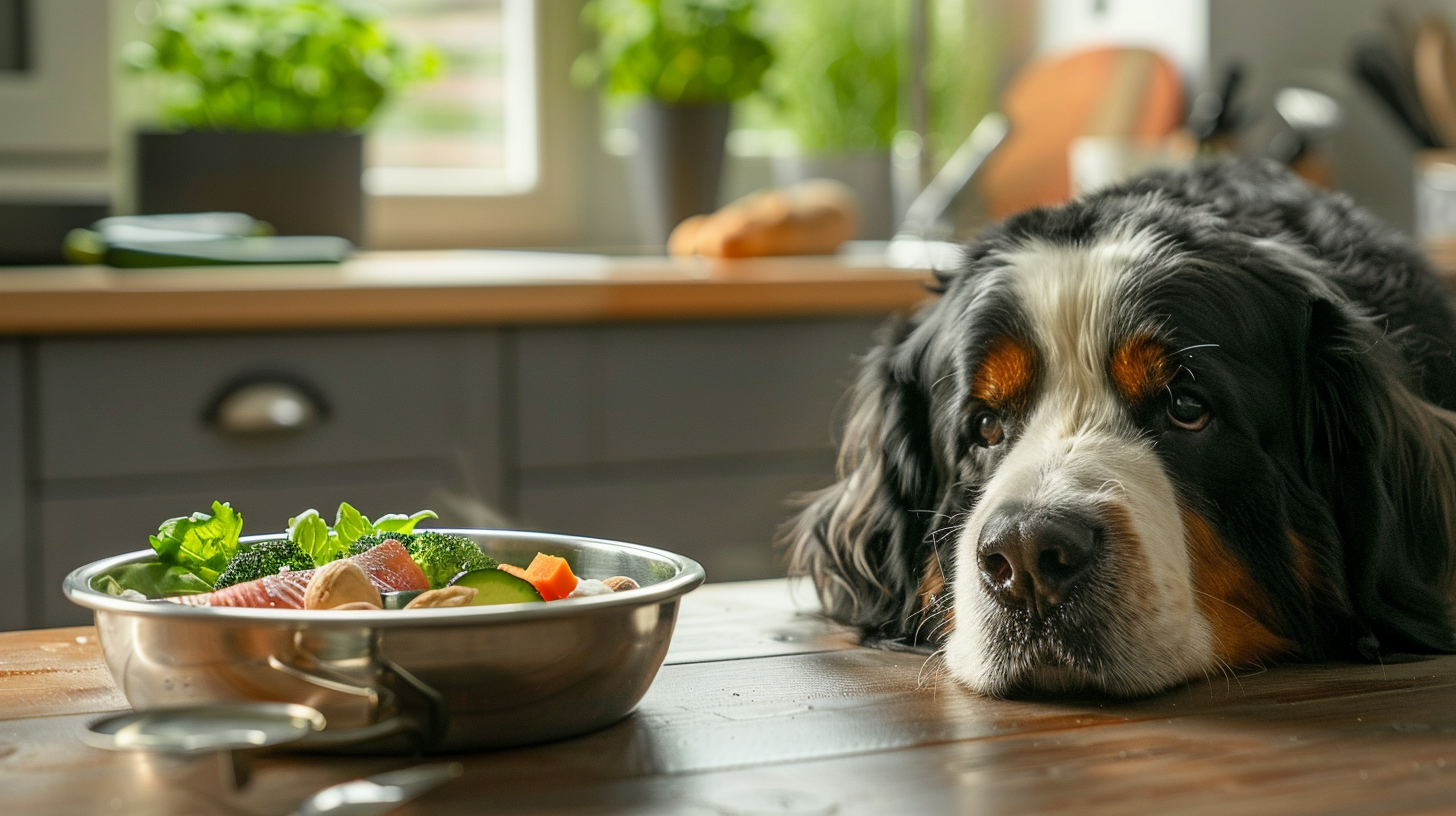
- Courgette, broccoli, steamed carrot
- Brown rice, buckwheat, sweet potato
- Green-lipped mussel oil or algae oil (for EPA and DHA)
- Beet pulp, Jerusalem artichoke (natural prebiotics)
Foods to limit or avoid:
- Gluten-rich cereals (wheat, rye, barley)
- Sugary treats or those made with wheat flour
- Potatoes, corn, white rice in excess
- Budget kibble high in starch
- Poor-quality animal fats
- Table scraps, bread, dairy products
FAQ
Conclusion
Feeding an arthritic dog well means acting on several physiological levers at once:
Key takeaways for feeding an arthritic dog
- Reduce inflammation with marine Omega-3 (EPA + DHA)
- Preserve muscle mass with high-quality protein
- Support gut microbiota with fermentable fibre and minimally processed food
- Stabilise body weight to limit pressure on the joints
But nutrition is only one pillar of care. Osteoarthritis is a chronic, multifactorial condition: to preserve the animal’s mobility and wellbeing, it must be addressed through a multimodal approach (balanced diet, appropriate physical activity, weight management, omega-3).
PERNIXOL®, developed by Laboratoire Sensilia, fits within this holistic approach. Its liquid formula, rich in EPA and DHA from New Zealand green-lipped mussel oil and algae oil, is designed to provide natural, lasting joint support as part of genuine multimodal care.
Discover PERNIXOL®
Scientific references
- Moreau M, Troncy E, Del Castillo JR, Bédard C, Gauvin D, Lussier B. Effects of feeding a high omega-3 fatty acids diet in dogs with naturally occurring osteoarthritis. J Anim Physiol Anim Nutr (Berl). 2013 Oct;97(5):830-7. doi: 10.1111/j.1439-0396.2012.01325.x. Epub 2012 Jul 14. PMID: 22805303.
- Stevens C, Norris S, Arbeeva L, Carter S, Enomoto M, Nelson AE, Lascelles BDX. Gut Microbiome and Osteoarthritis: Insights From the Naturally Occurring Canine Model of Osteoarthritis. Arthritis Rheumatol. 2024 Dec;76(12):1758-1763. doi: 10.1002/art.42956. Epub 2024 Aug 9. PMID: 39030898; PMCID: PMC11605265.
- Kealy RD, Lawler DF, Ballam JM, Mantz SL, Biery DN, Greeley EH, Lust G, Segre M, Smith GK, Stowe HD. Effects of diet restriction on life span and age-related changes in dogs. J Am Vet Med Assoc. 2002 May 1;220(9):1315-20. doi: 10.2460/javma.2002.220.1315. PMID: 11991408.
- Canine Arthritis Management, Diet and Supplements.
- Schmitz S, Suchodolski J. Understanding the canine intestinal microbiota and its modification by pro-, pre- and synbiotics - what is the evidence? Vet Med Sci. 2016 Jan 11;2(2):71-94. doi: 10.1002/vms3.17. PMID: 29067182; PMCID: PMC5645859.
- Carlisle C, Metzger BT, Tintle NL, Polley K, Jackson KH, Le Brun-Blashka S, Griffiths J, Harris WS. The Effects of Omega-3 Supplementation on the Omega-3 Index and Quality of Life and Pain Scores in Dogs. Animals. 2024; 14(21):3108. https://doi.org/10.3390/ani14213108
- Nelson AE, Arbeeva L, Johnson K, Savage-Guin S, Walker T, Enomoto M, Stevens C, Koskinen M, Cole T, Aker S, Thonen-Fleck C, Azcarate-Peril MA, Loeser RF, Renner JB, Golightly YM, Lascelles BDX. Cross-sectional associations of radiographic multiple joint osteoarthritis and symptoms, laboratory values and the gut microbiota: A multimodal study in humans and pet dogs. Osteoarthr Cartil Open. 2025 Sep 23;7(4):100682. doi: 10.1016/j.ocarto.2025.100682. PMID: 41078571; PMCID: PMC12510191.
- Balouei F, Rivera Cd, Paradis A, Stefanon B, Kelly S, McCarthy N, Mongillo P. Gut Microbiota Variation in Aging Dogs with Osteoarthritis. Animals. 2025; 15(11):1619. https://doi.org/10.3390/ani15111619
- Dr. Julia Grassinger, Canine gluten sensitivity – is this coeliac disease in dogs?, 2021
This article was written by the R&D team at Laboratoire Sensilia, experts in animal nutrition.



