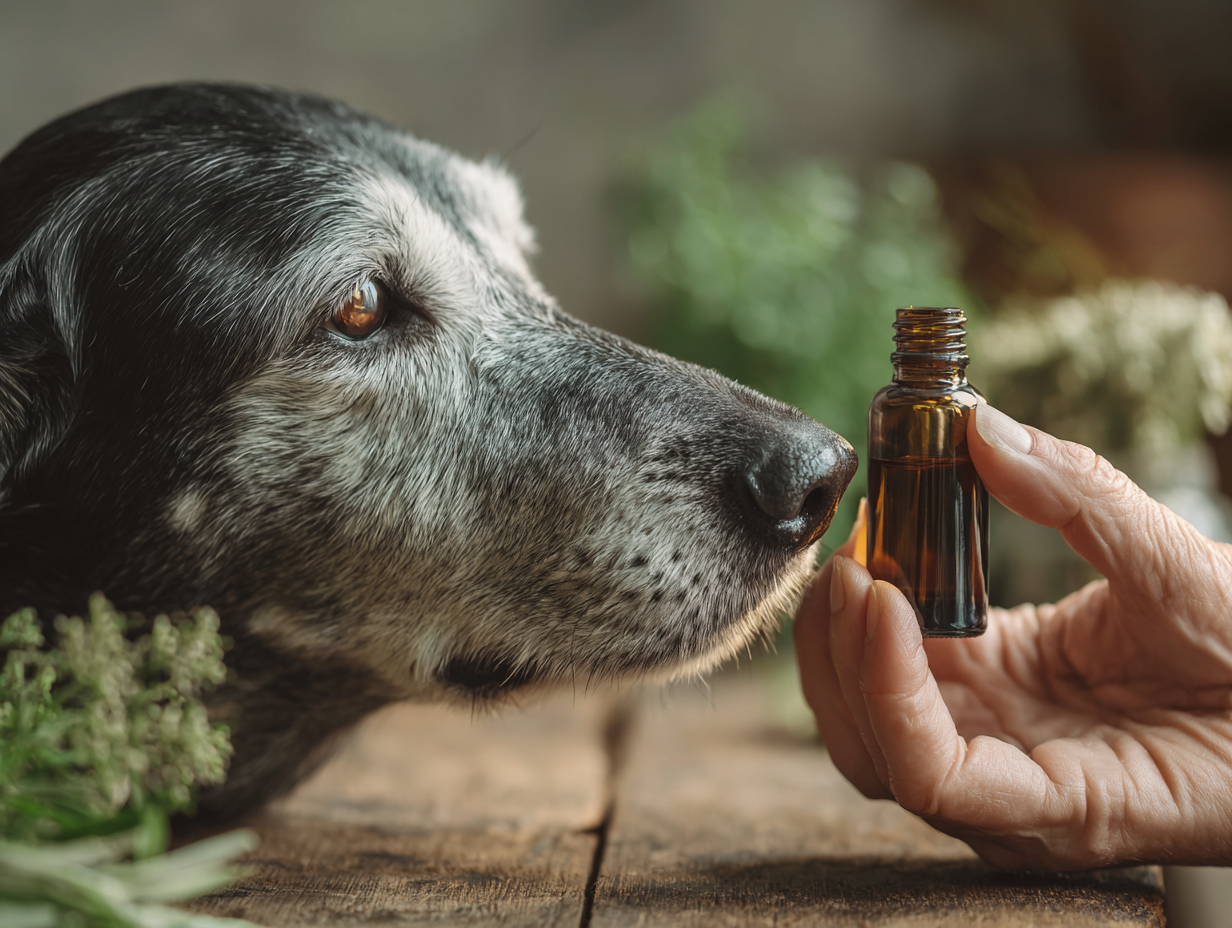
Essential oils for dogs: safe or risky?
Essential oils may offer some support for arthritic dogs, but only with veterinary guidance; they should never be used as an unsupervised treatment.
Pauline Durepaire
Published in
Natural IngredientsArthritis affects a large number of dogs and causes pain, stiffness and loss of mobility. Faced with this reality, some owners turn to essential oils, which are known for their anti-inflammatory and analgesic effects in humans.
But are these plant extracts, which are highly concentrated in active compounds, really suitable for dogs? They may have potential, but clinical evidence is lacking, and there are genuine toxicity risks.
This article examines the use of essential oils for canine arthritis: methods of use, the most studied oils, essential precautions and scientifically validated natural alternatives.
What is an essential oil?
An essential oil is a concentrated extract obtained by steam distillation or cold pressing of plant parts (flowers, leaves, bark, roots). It contains several hundred active compounds responsible for its therapeutic properties: antibacterial, antifungal, antiviral, calming, anti-inflammatory and analgesic.
How are essential oils used in dogs?
In dogs, essential oils must never be administered neat orally or topically. They are incorporated into suitable formulations, which reduce the risk of irritation and improve tolerance.
Par voie orale
- Dilution in vegetable oils: olive oil, grape seed, corn, evening primrose, borage… Common dilution: 5 to 20%.
- Honey: makes the preparation palatable, dilution 7 to 15%.
- Tablets: based on charcoal, algae or neutral lactose, which adsorb the essential oil.
- In food: a few drops (1 to 3) diluted in a vegetable oil then added to the ration.
On the skin
- Pure essential oils: sometimes used for local massage (spot-on), but only if the animal cannot lick the area.
- Dilution in vegetable oils: less commonly used in dogs because the coat limits penetration.
- Gels (carbomer) : widely used in veterinary rheumatology (3 to 5%, max 15%).
- Creams and ointments: mainly for wound healing, at low dilution (3–5%).
- Balms: blend of essential oils, vegetable oils and shea butter.
- Enriched shampoos: 1 drop per 10 ml of shampoo.
- Emulsions: temporary preparations with specific dispersants.
In diffusion
Rarely used in veterinary medicine because exposure is difficult to control. If it is used, it must be short, occasional, and always in a well-ventilated room.
Aromatherapy for canine arthritis
Arthritis is a degenerative joint disease that causes chronic inflammation, persistent pain and reduced mobility. In humans, essential oils are often used to relieve these symptoms thanks to their potential anti-inflammatory, analgesic and muscle-relaxant effects.
In veterinary medicine, the idea of using essential oils to support arthritic dogs appeals to many owners.
However, while these oils have a well-established pharmacological rationale in human medicine, specific clinical evidence in dogs remains limited or even non-existent. They should therefore be considered only as a complementary approach supervised by a veterinarian, rather than as a primary solution.
Essential oils for dog joints
Here is an overview of the main essential oils known for their anti-inflammatory properties, with their chemical constituents and mechanisms of action:
Essential oils with anti-inflammatory properties
| Essential Oil | Use | Precautions |
|---|---|---|
| Roman Chamomile (Chamaemelum nobile) | Internal & topical | Generally well tolerated. Avoid eyes and mucous membranes. Patch test recommended for sensitive skin. |
| Lemon Eucalyptus | Internal & topical | May cause respiratory irritation with prolonged diffusion. Avoid contact with mucous membranes. |
| Wintergreen | Topical only | Very high in salicylates: toxic if ingested. Contraindicated in puppies and during pregnancy. Never use undiluted; high dilution required. |
| Common Juniper | Topical only | Internal use contraindicated due to potential nephrotoxicity. Dilution is essential. |
| Rose Geranium | Internal & topical | May cause skin sensitization. Patch test recommended before use. |
| Italian Helichrysum (Immortelle) | Internal & topical | Anticoagulant properties. Use with caution before surgery. |
| Inula (Inula graveolens) | Internal & topical | Use caution when diffusing (possible respiratory irritation). Never use undiluted. |
| Bay Laurel | Internal & topical | Potential allergen. Patch test recommended. |
| Spike Lavender | Internal & topical | May cause irritation if used undiluted. Dilution recommended. |
| Lavandin | Internal & topical | Generally well tolerated, but follow the same precautions (dilution, avoid mucous membranes). |
| Peppermint | Internal & topical | Not recommended during lactation (may reduce milk production). Cooling effect. May irritate mucous membranes. |
| Palmarosa | Internal & topical | Possible skin sensitization. Patch test and proper dilution recommended. |
| Mountain Savory | Internal & topical | Very high in phenols (dermocaustic). Never use undiluted. Contraindicated in puppies and during pregnancy. Internal use only under veterinary supervision. |
| Tea tree | Internal & topical | Risk of irritation. Never apply undiluted to skin or mucous membranes. Use only for short, well-ventilated diffusion sessions. |
| Ylang-ylang | Internal & topical | May cause skin sensitization. Dilution and patch testing recommended. |
| Sweet Basil | Internal & topical | Use with caution during pregnancy. Never apply undiluted to the skin. Strict dilution required. |
Contraindications and precautions for use
Essential oils are strictly contraindicated in certain situations:
- Pregnancy: certain essential oils rich in ketones or with hormonal action (wormwood, tansy, clary sage) are prohibited.
- Lactation: peppermint, camphor and common sage disrupt lactation.
- Oral use: toxic oils include thuja, juniper, wormwood, absinthe and common sage.
- Topical use: essential oils rich in phenols (cinnamon, oregano, clove), garlic or terpenes are irritating and allergenic.
✘ Never on mucous membranes (nose, lips, ears, anogenital area), nor in the eyes.
✘ Never by injection (intravenous or intramuscular).
Key takeaways
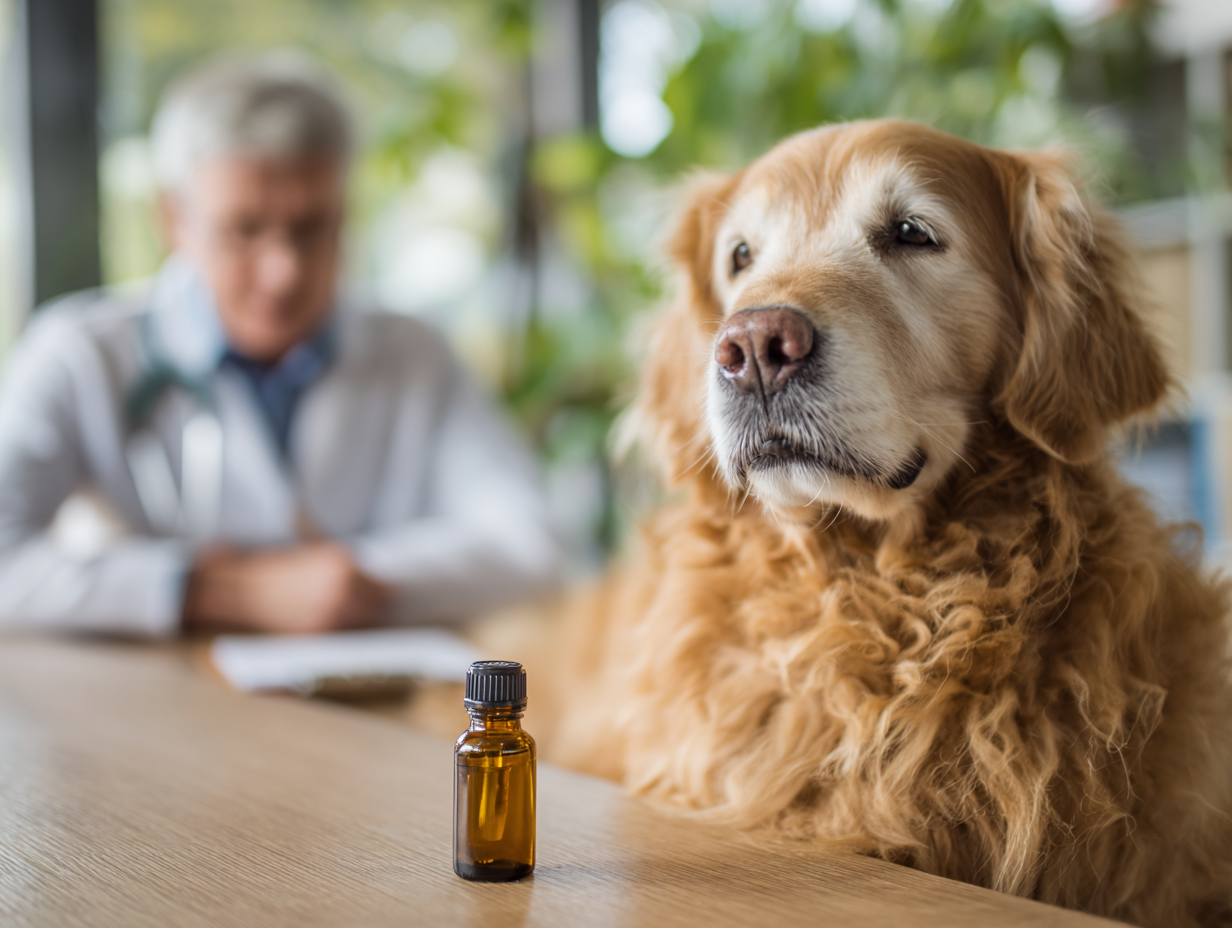
For arthritic dogs, aromatherapy should be viewed as an adjunct and not a main treatment.
Takeaways
- Never improvise doses.
- Use only suitable veterinary preparations.
- Always seek veterinary advice before administration.
- Monitor the animal and stop if an abnormal reaction occurs.
What scientifically validated alternatives are there?
While aromatherapy may look appealing on paper, the natural approaches that have genuinely demonstrated efficacy in arthritic dogs belong to a different category: marine omega-3 fatty acids and overall lifestyle support.
- Omega-3 fatty acids (EPA and DHA): several veterinary clinical trials have shown that supplementation with omega-3 fatty acids from marine oils helps reduce joint inflammation, improve mobility and lessen perceived pain in dogs with arthritis. These fatty acids act by modulating the production of inflammatory mediators (prostaglandins, leukotrienes, cytokines).
Discover our guide to Omega-3
- New Zealand green-lipped mussel oil: particularly rich in specific fatty acids such as ETA (eicosatetraenoic acid), it has shown promising results in improving locomotion and reducing lameness. Its unique, more diverse lipid profile compared with fish oil makes it a valuable option for joint disorders in dogs.
- Weight management: excess weight is one of the main aggravating factors in arthritis. Longitudinal studies have shown that a dog kept lean develops signs of arthritis several years later than an overweight dog. Weight management is therefore a key factor in prevention and slowing disease progression.
- Gentle exercise and physiotherapy: regular, appropriately adapted activity (moderate walks, swimming, underwater treadmill) helps preserve muscle mass and joint flexibility without causing overload. Canine physiotherapy, where available, effectively complements this approach.
In summary: to support the mobility of an arthritic dog, omega-3 fatty acids, green-lipped mussel oil, weight management and gentle exercise are currently the most scientifically documented natural solutions.
FAQ
Conclusion
Aromatherapy is a rich and promising field. Certain essential oils have well-known anti-inflammatory and analgesic properties, and their use in human medicine is documented. But in arthritic dogs, the reality is different: clinical evidence is lacking and toxicity risks are very real.
Essential oils must therefore never be used for self-medication. They may be used as an adjunct, in the form of specific veterinary preparations, and only under professional supervision.
To effectively and safely support the mobility of an arthritic dog, scientifically validated solutions remain the most reliable: omega-3 fatty acids, green-lipped mussel oil, weight management and gentle physiotherapy.
Scientific references
- Chevalley A. Aromatherapy in veterinary medicine: interest and applications. Thèse de doctorat vétérinaire, Université Claude Bernard Lyon 1. 2016.
- Cap Douleur. The role of aromatherapy in veterinary medicine and its application in pain management. 2023.
- Barbeau-Grégoire M, Otis C, Cournoyer A, Moreau M, Lussier B, Troncy E. A 2022 Systematic Review and Meta-Analysis of Enriched Therapeutic Diets and Nutraceuticals in Canine and Feline Osteoarthritis. International Journal of Molecular Sciences. 2022; 23(18):10384. https://doi.org/10.3390/ijms231810384
This article was written by the R&D team at Laboratoire Sensilia, experts in animal nutrition.



