Krill Oil for Dogs: Joint Benefits, Risks & Alternatives
Krill oil delivers omega-3 fatty acids as phospholipids for better joint and brain uptake, but harvesting it comes with serious limitations.
Pauline Durepaire
Published in
Natural IngredientsOsteoarthritis is a common chronic disease that affects the mobility and comfort of many dogs. Marine omega-3 supplements are increasingly recommended for their powerful anti-inflammatory role and their ability to modulate joint pain.
Antarctic krill oil (Euphausia superba) is often presented as a highly effective source of omega-3 fatty acids due to its distinctive phospholipid structure, which supports efficient absorption.
However, this small crustacean is also at the heart of major environmental issues: it is the cornerstone of the Antarctic food chain, and intensive fishing directly threatens the balance of marine ecosystems.
This comprehensive guide explores the evidence-based benefits of krill oil in dogs, its mechanism of action, and above all the ethical limitations and more sustainable alternatives available today.
What is Antarctic Krill?
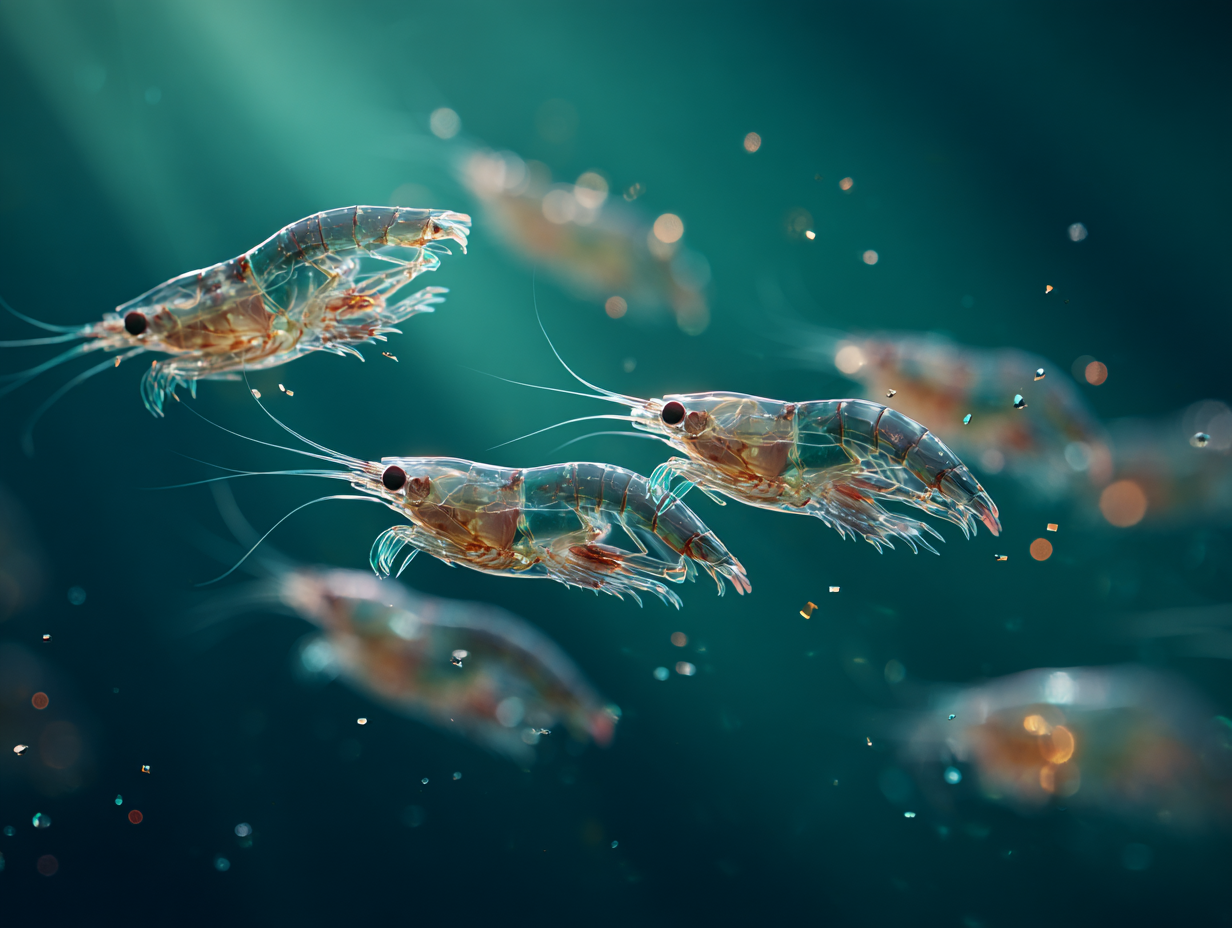
Antarctic krill (Euphausia superba) is a small shrimp-like crustacean that lives in the cold waters of the Southern Ocean around Antarctica. It is a key part of the marine ecosystem, serving as the main food source for many animals, including whales, seals, penguins and numerous fish.
Krill also plays a crucial role in the carbon cycle. By feeding on carbon-rich phytoplankton and then excreting waste into the depths of the ocean, it helps sequester atmospheric carbon dioxide (CO₂) in the seabed.
The oil extracted from this crustacean is widely used in supplements because it is rich in omega-3 fatty acids, particularly EPA and DHA. Unlike fish oils, in which omega-3 fatty acids are present as triglycerides, those in krill oil are predominantly present as phospholipids.
Phospholipids are lipids that form part of cell membranes in both humans and dogs. Providing omega-3 fatty acids in phospholipid form may support better absorption and assimilation by the dog's body and brain than the triglyceride form found in conventional fish oils.
Krill oil also naturally contains astaxanthin, a powerful antioxidant that protects cells against free radicals and gives the oil its red colour.
What are the benefits of krill oil?
The effects of krill oil stem mainly from its unique profile of long-chain Omega-3 (EPA and DHA) and the antioxidant astaxanthin, both delivered in a highly bioavailable form: phospholipids.
Anti-inflammatory action
The main role of Omega-3 in joint support and reducing the symptoms of osteoarthritis in dogs is the modulation of the inflammatory response.
- Fatty acid replacement: After ingestion and digestion, EPA (eicosapentaenoic acid) and DHA (docosahexaenoic acid) are incorporated into cell membranes. This incorporation is facilitated by the phospholipid structure of krill.
- Resolution of inflammation: EPA and DHA are also precursors of resolvins and protectins, specialized molecules that actively participate in the resolution phase of inflammation. These molecules help extinguish the inflammatory response after it is triggered.
Antioxydant power
Astaxanthin, a carotenoid present in krill oil, acts as a powerful antioxidant (Bengtson Nash et al., 2014).
- Cellular protection: Astaxanthin neutralizes free radicals (unstable molecules that damage cells). Krill oil has also shown protective properties against oxidative stress and neuroinflammation in animal models (Choi et al., 2017).
- Synergy: Astaxanthin acts in synergy with the anti-inflammatory effect of Omega-3 by protecting lipids against oxidation.
Impact on cognitive function
DHA is a major component of neuronal membranes. Its incorporation into the brain via phospholipids supports membrane fluidity and nerve signal transmission.
Krill oil has demonstrated a protective effect against cognitive disorders and neuroinflammation in animal models (Choi et al., 2017), suggesting a potential role in supporting brain function in ageing dogs.
What clinical studies say about dogs
Marine omega-3 fatty acids are widely recognised for their benefits to canine health, particularly for joint support and the regulation of inflammation. Krill oil, with its highly bioavailable phospholipid form, shows promising benefits:
- Management of pain associated with osteoarthritis in dogs:
- A 2024 study evaluated the efficacy of a green-lipped mussel extract combined with krill oil for treating pain in arthritic dogs. It concluded that this combination is an effective treatment option. (Kampa et al., 2024)
- Furthermore, in vitro research has shown that krill oil was effective at protecting canine cartilage against cytokine-induced degradation (Buddhachat et al., 2017).
- Improved skin and coat health: A study conducted on Beagle dogs concluded that krill oil effectively increased EPA and DHA concentrations in plasma and coat lipids (Lindqvist et al., 2023). The same study observed an improvement in coat quality.
Limitations and drawbacks of krill oil
Despite its advantages, the use of krill oil is not without limitations, particularly from an ethical and environmental standpoint.
Environmental impact and overfishing
Antarctic krill fishing, intended for aquaculture and the production of dietary supplements, is a source of ecological concern.
- Threat to the food chain: Krill is at the base of the Antarctic food chain. Intensive and concentrated fishing in predator feeding areas (whales, seals, penguins) jeopardizes the vital food supply of these species.
- Compounding climate pressures: The Antarctic ecosystem is already weakened by warming waters and melting sea ice, the natural habitat of young krill. In this context, overfishing further increases pressure on this fragile ecosystem.
- Concentrated fishing and exceeded quotas: Reports highlight significant tensions on the resource, notably a strong concentration of fishing in critical zones and record catches. A concrete example of this tension is the announcement of early fishery closures in 2025 after quotas were exceeded, illustrating the difficulty of managing the resource sustainably in this fragile environment.
Risk of contamination
Although krill oils are generally considered low in contaminants, studies have highlighted a risk of contamination by heavy metals (such as arsenic) and oxidized lipids, which must be monitored to ensure product safety (Zhang et al., 2025; Kizilirmak et al., 2021).
What more sustainable alternatives to krill oil?
Faced with the growing limitations linked to krill, several sources of Omega-3 are emerging today as safer, more stable, and significantly more sustainable options. Two of them stand out particularly: microalgae oil and green lipped mussel oil.
Microalgae oil
Marine microalgae are the aquatic organisms that naturally synthesize EPA and DHA, which offers numerous advantages:
- Stable composition: The EPA and DHA concentrations in microalgae oil are not affected by seasonal or geographic variations.
- Superior purity: Because they are cultivated in controlled environments, microalgae are isolated from marine contaminants such as heavy metals, dioxins and PCBs.
- Optimal sustainability: Their cultivation places no pressure on wild fish stocks and does not affect fragile marine ecosystems.
- Complete traceability: Each batch can be fully controlled, from cultivation to extraction, which guarantees reproducible product quality.
Microalgae oil is now a preferred source of EPA and DHA for many laboratories committed to ethical solutions in animal and human health.
Learn more about algae oil
Green-Lipped Mussel Oil
New Zealand green-lipped mussel (Perna canaliculus) is recognised as a versatile solution for joint support. Its unique lipid composition provides multiple benefits:
- It contains both EPA and DHA.
- It is rich in other rare omega-3 fatty acids, such as ETA (eicosatetraenoic acid), which are recognised for their powerful anti-inflammatory effects.
- It naturally contains antioxidants, including carotenoids and furan fatty acids.
- The green-lipped mussel industry is strictly regulated by the New Zealand government, supporting sustainable harvesting and limiting pressure on wild stocks, unlike krill fishing.
Learn more about green-lipped mussel oil
FAQ
Conclusion
Antarctic krill oil is an excellent dietary supplement for dogs, notably thanks to the superior bioavailability of its Omega-3 in phospholipid form, as well as the presence of the antioxidant astaxanthin.
Studies support its potential to promote joint health, reduce osteoarthritis symptoms and improve coat quality.
However, it is essential to highlight the major ethical and environmental concerns associated with its harvesting in a fragile Antarctic ecosystem, as well as the contamination risk that requires monitoring.
Choosing brands that guarantee sustainable and responsible fishing is crucial. Alternatives such as green-lipped mussel oil or microalgae oil, sustainable sources rich in EPA and DHA, can provide an effective omega-3 intake for joint support.
To provide a comprehensive and more sustainable solution for your dog's mobility, Laboratoire Sensilia has developed PERNIXOL®, a natural joint supplement that combines proven efficacy and sustainability.
Discover PERNIXOL®
Scientific references
- Mao L, Wang F, Li Y, Dai Y, Liu Y, Wang J, Xue C. Oil from Antarctic krill (Euphausia superba) facilitates bone formation in dexamethasone-treated mice. Food Sci Biotechnol. 2018 Sep 14;28(2):539-545. doi: 10.1007/s10068-018-0463-5. PMID: 30956866; PMCID: PMC6431344.
- Liu Y, Robinson AM, Su XQ, Nurgali K. Krill Oil and Its Bioactive Components as a Potential Therapy for Inflammatory Bowel Disease: Insights from In Vivo and In Vitro Studies. Biomolecules. 2024 Apr 6;14(4):447. doi: 10.3390/biom14040447. PMID: 38672464; PMCID: PMC11048140.
- Kampa N, Kaenkangploo D, Jitpean S, Srithunyarat T, Seesupa S, Hoisang S, Yongvanit K, Kamlangchai P, Tuchpramuk P, Lascelles BDX. Evaluation of the comparative efficacy of green lipped mussel plus krill oil extracts (EAB-277), Biota orientalis extracts or NSAIDs for the treatment of dogs with osteoarthritis associated pain: a blinded, placebo-controlled study. Front Vet Sci. 2024 Oct 10;11:1464549. doi: 10.3389/fvets.2024.1464549. PMID: 39450405; PMCID: PMC11500327.
- Wang W, Xu L, Cao Y, Liu G, Zhang Y, Wang X, Mao X. Effects of supplementation with krill oil on blood parameters, hair quality, and fecal microbiota in male beagle dogs. Front Microbiol. 2025 Aug 1;16:1587149. doi: 10.3389/fmicb.2025.1587149. PMID: 40822403; PMCID: PMC12354513.
- Lindqvist H, Dominguez T, Dragøy R, Ding Y, Burri L. Comparison of Fish, Krill and Flaxseed as Omega-3 Sources to Increase the Omega-3 Index in Dogs. Vet Sci. 2023 Feb 18;10(2):162. doi: 10.3390/vetsci10020162. PMID: 36851466; PMCID: PMC9961762.
- Buddhachat K, Siengdee P, Chomdej S, Soontornvipart K, Nganvongpanit K. Effects of different omega-3 sources, fish oil, krill oil, and green-lipped mussel against cytokine-mediated canine cartilage degradation. In Vitro Cell Dev Biol Anim. 2017 May;53(5):448-457. doi: 10.1007/s11626-016-0125-y. Epub 2017 Jan 11. PMID: 28078500.
- Zhang H, Ji Y, Jiang Z, Yang G, Kong C, Shen Z, Yuan T, Shen X. Arsenic toxicity in Antarctic krill oil and its impact on human intestinal cells. Ecotoxicol Environ Saf. 2025 Jan 1;289:117680. doi: 10.1016/j.ecoenv.2025.117680. Epub 2025 Jan 10. PMID: 39798443.
- Choi JY, Jang JS, Son DJ, Im HS, Kim JY, Park JE, Choi WR, Han SB, Hong JT. Antarctic Krill Oil Diet Protects against Lipopolysaccharide-Induced Oxidative Stress, Neuroinflammation and Cognitive Impairment. Int J Mol Sci. 2017 Nov 28;18(12):2554. doi: 10.3390/ijms18122554. PMID: 29182579; PMCID: PMC5751157.
- Bengtson Nash SM, Schlabach M, Nichols PD. A nutritional-toxicological assessment of Antarctic krill oil versus fish oil dietary supplements. Nutrients. 2014 Aug 28;6(9):3382-402. doi: 10.3390/nu6093382. PMID: 25170991; PMCID: PMC4179167.
- Kizilirmak, F.E.; Aslan, R.; Çeti̇ngül, I.S.; Gülay, Ö.Y.; Gülay, M.Ş. Risk of Heavy Metal Contamination in Krill Oils. Kocatepe Veter- J. 2021, https://doi.org/10.30607/kvj.960071.
This article was written by the R&D team at Laboratoire Sensilia, experts in animal nutrition.



