New Zealand Green-Lipped Mussel: Origin, Farming & Omega-3 Oil
Learn where New Zealand green-lipped mussels come from, how they are farmed sustainably and how their omega-3-rich oil is extracted.
Pauline Durepaire
Published in
Natural IngredientsThe New Zealand green-lipped mussel (Perna canaliculus) is one of the most extensively studied marine sources of omega-3 in the field of joint comfort. Used in many dietary supplements for humans and dogs, it also attracts attention for its unique farming method and naturally high marine lipid content.
But behind green-lipped mussel oil lies a much broader story: that of a New Zealand coastal ecosystem, an endemic species deeply linked to Māori traditions and an aquaculture industry considered among the most resource-efficient in the world.
How is the green-lipped mussel farmed? Why does it play an important role in marine ecosystems? How is the oil extracted to preserve its precious active compounds?
From the origins of the green-lipped mussel to modern methods of extracting its oil, this article explores the history, ecosystem, and sustainability of this unique marine ingredient.
A unique marine ecosystem
The New Zealand green-lipped mussel (Perna canaliculus) is known for its naturally high content of marine lipids and omega-3. Before being used in dietary supplements, however, this species is first and foremost a central part of New Zealand's coastal ecosystems.
Endemic to Aotearoa, the Māori name for New Zealand, the green-lipped mussel grows exclusively in certain coastal areas of the country, notably in the Marlborough Sounds, the Hauraki Gulf, and several sheltered bays rich in phytoplankton.
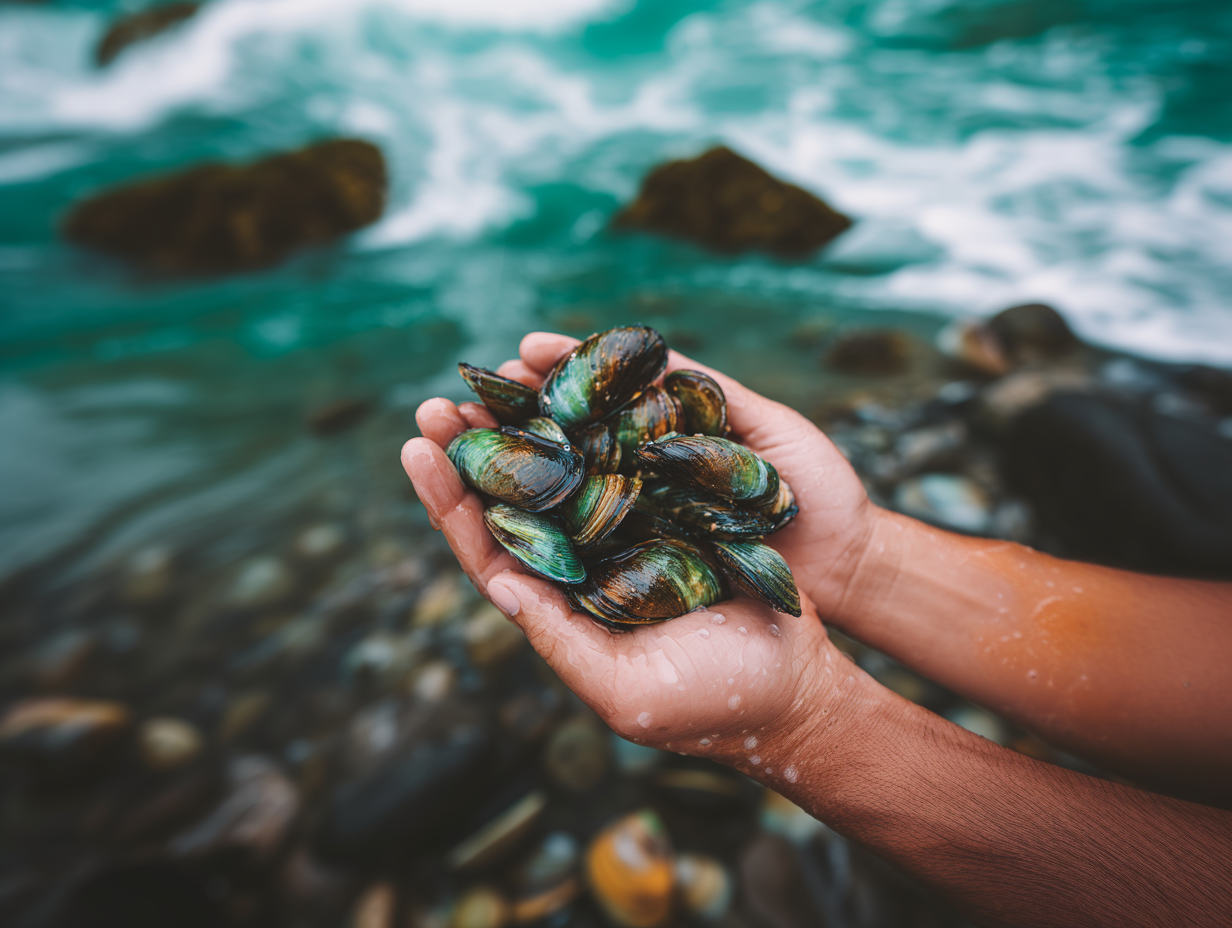
Recognisable by the green edge of its shell, it can live on rocky substrates as well as sandy or muddy seabeds. In the wild, mussels sometimes form extensive underwater reefs capable of sheltering numerous marine species.
A heritage linked to Māori culture
Long before the development of modern aquaculture, the green-lipped mussel was already part of the traditional Māori diet.
Coastal communities harvested mussels according to the seasons and consumed them fresh, dried or preserved. Certain harvesting practices and methods of managing coastal areas were guided by principles of long-term marine resource conservation.
In Māori culture, this relationship with the coastline is rooted in the principle of kaitiakitanga, which denotes a form of responsibility and stewardship of living things.
The green-lipped mussel still holds an important place in this New Zealand maritime heritage today.
A key species for local biodiversity
The green-lipped mussel is a filter-feeding mollusc. It feeds by filtering seawater to capture phytoplankton and organic particles in suspension.
This function plays several ecological roles:
- contribution to water clarification,
- circulation of nutrients within the ecosystem,
- creation of habitats for other marine species,
- stabilisation of certain coastal areas.
Mussel reefs also serve as a refuge for numerous marine organisms such as crustaceans, algae, invertebrates and juvenile fish.
The presence of mussel beds is often considered an indicator of good ecological health in coastal areas.
From wild harvest to modern aquaculture
Until the mid-20th century, green-lipped mussels were mainly harvested in the wild. Rising demand and certain intensive fishing methods gradually weakened several natural reefs.
In response to this pressure, New Zealand developed green-lipped mussel aquaculture from the 1960s onwards.
Farming closely linked to natural cycles
Today, most green-lipped mussels are farmed using longline systems:
- long floating lines held up by buoys,
- from which vertical ropes are suspended,
- on which young mussels attach and grow.
This method allows mussels to develop directly in their natural environment, without artificial feeding.
The reproduction of the green-lipped mussel also remains closely linked to natural ocean cycles. Adults release their gametes into the water, and the larvae then drift for several weeks before attaching to various marine substrates. Once they settle, juvenile mussels are known as spat.
A significant part of New Zealand aquaculture still depends on this wild spat, collected naturally before being transferred to grow-out ropes.
A rapid harvest to preserve quality
Mussels generally reach harvest size after 12 to 24 months of growth.
Harvesting is carried out on board specialised vessels capable of hauling up the long grow-out ropes using hydraulic systems. The mussels are then mechanically separated, rinsed, and sorted directly on the boat.
The speed of this step is essential to preserve the quality of the flesh and, above all, the stability of naturally occurring marine lipids, which are sensitive to oxidation.
After harvest:
- mussels are rapidly transported to processing centres,
- the flesh is stabilised at low temperature,
- then prepared for lipid extraction.
From mussel to oil
Green-lipped mussel oil is obtained through a process called supercritical CO₂ extraction.
This technology makes it possible to extract marine lipids while limiting their degradation. Because the omega-3 fatty acids found in green-lipped mussels are particularly sensitive to heat and oxygen, this step is crucial for preserving their quality.
The process uses carbon dioxide in a supercritical state, with properties of both a liquid and a gas. In this state, CO₂ acts as a natural solvent capable of extracting lipids without using harsh chemical solvents.
Why use supercritical CO₂ extraction?
This method offers several advantages:
- low-temperature extraction,
- better preservation of marine fatty acids,
- absence of chemical residues,
- high concentration of bioactive lipids,
- a significant reduction in protein and allergen content.
The oil obtained is then filtered and protected from oxidation to preserve its stability.
A sustainable resource
Green-lipped mussel farming is often considered one of the most resource-efficient forms of aquaculture.
Unlike other animal production systems, mussels:
- do not require industrial feed,
- use very little freshwater,
- feed naturally on phytoplankton present in the water.
Life cycle analyses carried out in New Zealand also show that farmed mussels have a relatively low carbon footprint compared to many other animal protein sources.
Green-lipped mussel farming generates approximately 30 times fewer CO₂ emissions than beef production, with a carbon footprint even lower than that of tofu.
In the face of climate challenges
Even though green-lipped mussel farming is considered relatively sustainable, it remains highly dependent on ocean health. Several factors can affect mussel populations and aquaculture production: warming waters, ocean acidification, summer mortality events and changes in ocean currents.
Water quality and the resilience of coastal ecosystems are therefore essential to preserving this resource over the long term.
In response to these challenges, several ecological restoration programmes are now being developed in New Zealand to protect coastal habitats and recreate natural mussel reefs.
These projects aim in particular to:
- restore certain areas that have been historically degraded,
- promote marine biodiversity,
- improve the resilience of coastal ecosystems,
- recreate habitats for fish and invertebrates,
- support coastal water quality.
FAQ
Conclusion
The New Zealand green-lipped mussel is more than a marine ingredient rich in omega-3. Its value also reflects the ecosystem in which it grows: coastal waters rich in phytoplankton, reefs that support marine biodiversity and an aquaculture sector that remains closely dependent on the natural balance of marine ecosystems.
From wild spat collection to longline farming, through to supercritical CO₂ oil extraction, each step aims to preserve the quality of the marine lipids naturally present in Perna canaliculus.
The green-lipped mussel also illustrates the current challenges of sustainable aquaculture: production with limited inputs, preservation of coastal ecosystems and adaptation to the effects of climate change.
For PERNIXOL®, Laboratoire Sensilia chose New Zealand green-lipped mussel oil for its naturally high marine lipid content, as part of an approach that prioritises raw material quality, traceability and the environment of origin.


Scientific references
- Alvarenga, R., Dewulf, J., Guinée, J., et al. Life Cycle Assessment of NZ Mussels and Oysters. Prepared for the New Zealand Ministry for Primary Industries (MPI), Wellington, New Zealand, 2021.
- Elofsson, M., et al., Shellfish Aquaculture and Ecosystem Services: A Review, Frontiers in Marine Science. 2022;9:954404. DOI : 10.3389/fmars.2022.954404
- Jeffs, A. G., Gardner, J. P. A., et al., Greenshell™ Mussel Aquaculture in New Zealand: Environmental Interactions and Sustainability Perspectives, New Zealand Journal of Marine and Freshwater Research. 2018. DOI : 10.1080/00288330.2018.1506487
- Ministry for Primary Industries (MPI). Green-Lipped Mussel Fisheries Assessment Plenary May 2025 – Volume 1. Wellington, New Zealand, 2025.
- NIWA – National Institute of Water and Atmospheric Research. Greenshell™ Mussel Aquaculture.
- Shadbolt, M., Kelly, S., Jeffs, A., Marine Farming and Greenshell Mussel Ecosystems in New Zealand, New Zealand Journal of Marine and Freshwater Research. 2018;52(4):495-515. DOI : 10.1080/00288330.2018.1506487
- The Department of Conservation New Zealand, Marine Farms and the Environment. Wellington, New Zealand.
- Zuidema, S., et al., Carbon Footprint of New Zealand Shellfish Aquaculture, Sustainability. 2023;15(5):3912. DOI : 10.3390/su15053912
This article was written by the R&D team at Laboratoire Sensilia, experts in animal nutrition.



