Omega-3 for dogs: phospholipids or triglycerides?
Omega-3s for dogs: discover how phospholipid and triglyceride forms differ in absorption and their potential benefits for joint health.
Pauline Durepaire
Published in
Omega-3When it comes to joint comfort in dogs, Omega-3 fatty acids are now recognised as valuable allies. Their natural anti-inflammatory effect, particularly via EPA (eicosapentaenoic acid) and DHA (docosahexaenoic acid), is well documented.
But what is less well known is that their effectiveness also depends on their molecular form.
Phospholipids or triglycerides? These two structures play a key role in the absorption of omega-3s and therefore in their effect on joint mobility.
So, what is the best form of Omega-3 for your dog? Let's break it down.
What are triglycerides and phospholipids?
Triglycerides
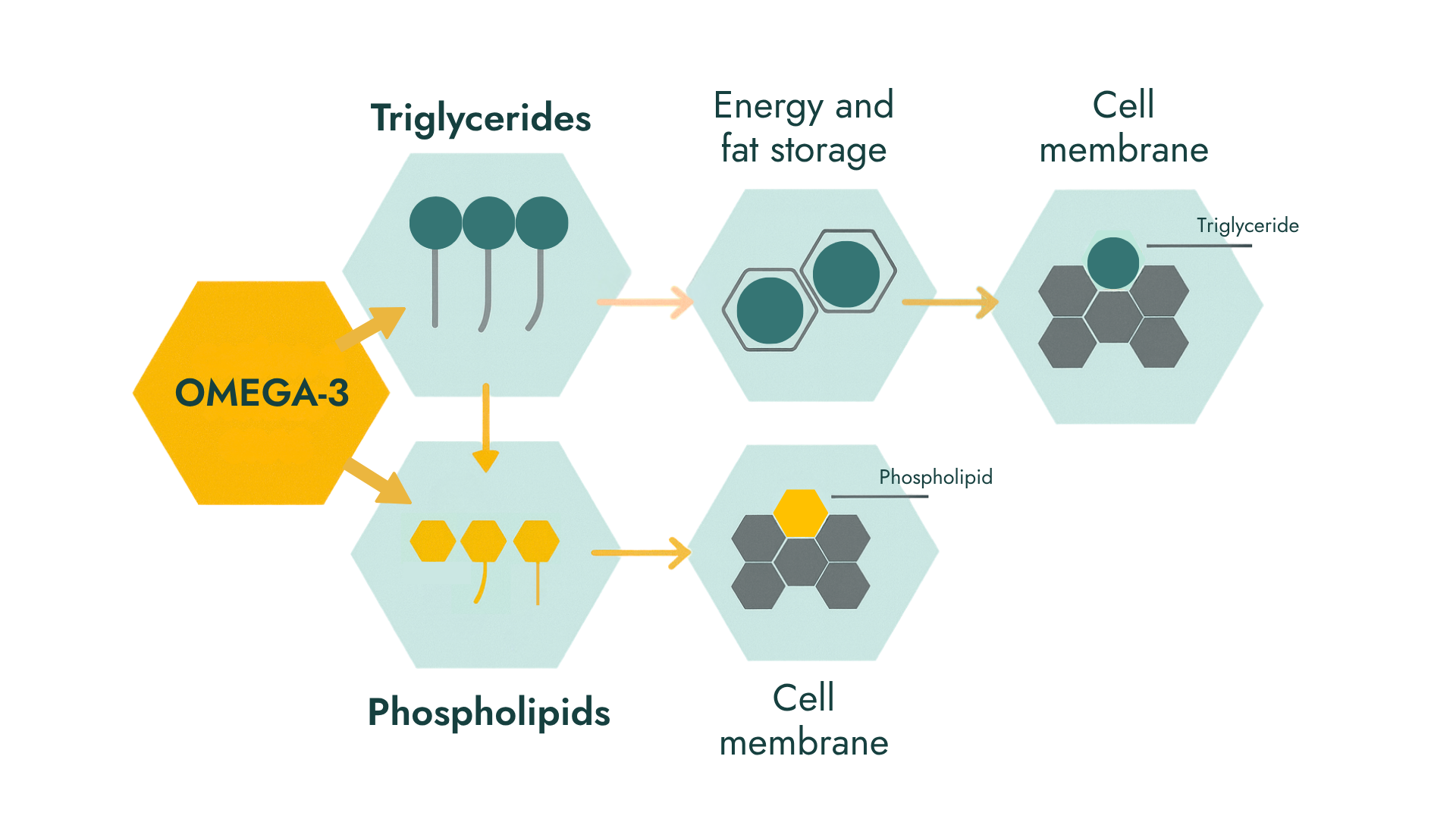
Triglycerides are the natural form in which the majority of dietary fats are found. A triglyceride is a molecule made up of three fatty acids attached to a structure called glycerol. This form is very common in fish oils and conventional vegetable oils.
Phospholipids
Phospholipids are a special category of lipids. Unlike triglycerides, they contain only two fatty acids, but also have an additional hydrophilic phosphate group. This characteristic gives them an amphiphilic structure: one end attracts water (hydrophilic), while the other repels it (hydrophobic).
This dual affinity allows them to naturally assemble into lipid bilayers, the basic structure of cell membranes in all living organisms, including dogs.
During digestion, this amphiphilic architecture facilitates their incorporation into micelles, the small particles that transport fats across the intestinal wall. The result: Omega-3s in phospholipid form are absorbed more quickly and more efficiently, even at low doses.
In summary, a dog's body recognises and utilises phospholipid Omega-3s more easily, as their structure is naturally compatible with that of the dog's own cells.
What science says about Omega-3 absorption
Several studies have compared the body's ability to absorb omega-3s in different molecular forms and found that phospholipids are generally better absorbed than triglycerides.
A clinical study published in Lipids in Health and Disease (Schuchardt et al., 2011) showed that krill oil (rich in Omega-3 in phospholipid form) resulted in significantly higher incorporation of EPA and DHA into cell membranes than Omega-3 in triglyceride or ethyl ester form.
Another study, conducted by Köhler et al. (2015), found that phospholipids were absorbed more quickly and more efficiently than standard triglycerides, even at equivalent doses.
Omega-3s in phospholipid form exert more pronounced anti-inflammatory and metabolic effects than those in triglyceride form.
These results suggest that, for dogs prone to inflammatory joint problems, the phospholipid form may be the most appropriate.
Discover our Omega-3 guide
Marine oils rich in phospholipids
Some oils stand out for their high phospholipid content, a structure that promotes cellular absorption of Omega-3s. These include:
- Antarctic krill oil (Euphausia superba), often considered the benchmark: it naturally contains 30 to 60% phospholipids, mainly in the form of phosphatidylcholine, which explains its very good bioavailability observed in numerous clinical studies.
- New Zealand green-lipped mussel oil (Perna canaliculus), whose phospholipid fraction can reach 70 to 80% in certain extracts obtained using polar solvents such as ethanol.
- To a lesser extent, other oils from microscopic marine organisms (certain microalgae or zooplankton) also contain a significant phospholipid fraction.
The influence of the extraction method
The phospholipid content of a marine oil depends largely on the extraction process used:
- Solvent extraction
- Supercritical CO₂ extraction
Processes using a polar solvent (such as ethanol) efficiently extract the phospholipid fraction, as these molecules are amphiphilic (both hydrophilic and hydrophobic) and partially dissolve in polar solvents. The resulting extracts retain a structure close to that of cell membranes, hence their excellent bioavailability.
In contrast, modern supercritical CO₂ extraction processes, highly valued for their purity and their ability to preserve the raw material, yield an oil that is almost devoid of phospholipids (< 5%). As CO₂ is a non-polar solvent, it primarily extracts triglycerides and free fatty acids, but very little of the polar lipids.
The result is an oil that is more stable, more concentrated in EPA and DHA, but whose Omega-3s are present mainly in triglyceride form, and therefore potentially slightly less bioavailable than those bound to phospholipids.
This in no way diminishes the nutritional value of these extracts: CO₂ technology remains the cleanest, the safest and particularly effective at preserving fragile fatty acids (no solvents, no residues, no thermal oxidation). This explains why two oils derived from the same green-lipped mussel can display very different absorption profiles depending on their extraction method.
FAQ
Conclusion
Omega-3s are essential nutrients for a dog's wellbeing, but not all forms are equal.
Their molecular structure and extraction process play a decisive role in their bioavailability and effectiveness.
Omega-3s bound to phospholipids are generally better absorbed and more biologically active than those in triglyceride form, as they integrate more easily into cell membranes.
Marine oils obtained through polar extraction, such as krill oil or green-lipped mussel oil extracted with ethanol, are naturally richer in phospholipids.
In contrast, oils obtained by supercritical CO₂ extraction, such as the method used in PERNIXOL®, contain mainly triglycerides and free fatty acids, but offer other major advantages: exceptional purity, enhanced oxidative stability and optimal preservation of EPA and DHA thanks to gentle extraction, free of solvents and excessive heat.
This is the approach chosen by Laboratoire Sensilia: a liquid formula combining CO₂-extracted green-lipped mussel oil and microalgae oil to provide dogs with highly concentrated, stable and well-tolerated omega-3s.
Discover PERNIXOL®
Scientific references
- Schuchardt, J.P., Schneider, I., Meyer, H. et al. Incorporation of EPA and DHA into plasma phospholipids in response to different omega-3 fatty acid formulations - a comparative bioavailability study of fish oil vs. krill oil. Lipids Health Dis 10, 145 (2011). https://doi.org/10.1186/1476-511X-10-145
- Köhler A, Sarkkinen E, Tapola N, Niskanen T, Bruheim I. Bioavailability of fatty acids from krill oil, krill meal and fish oil in healthy subjects--a randomized, single-dose, cross-over trial. Lipids Health Dis. 2015 Mar 15;14:19. doi: 10.1186/s12944-015-0015-4. PMID: 25884846; PMCID: PMC4374210.
- Burri L, Hoem N, Banni S, Berge K. Marine omega-3 phospholipids: metabolism and biological activities. Int J Mol Sci. 2012 Nov 21;13(11):15401-19. doi: 10.3390/ijms131115401. PMID: 23203133; PMCID: PMC3509649.
- Rossmeisl M, Medrikova D, van Schothorst EM, Pavlisova J, Kuda O, Hensler M, Bardova K, Flachs P, Stankova B, Vecka M, Tvrzicka E, Zak A, Keijer J, Kopecky J. Omega-3 phospholipids from fish suppress hepatic steatosis by integrated inhibition of biosynthetic pathways in dietary obese mice. Biochim Biophys Acta. 2014 Feb;1841(2):267-78. doi: 10.1016/j.bbalip.2013.11.010. PMID: 24295779.
This article was written by the R&D team at Sensilia Laboratories, specialists in animal nutrition.



